
Backpack Vacuum vs Upright for Allergies: Which One Keeps Dust Out of the Air?
For allergy-prone homes, a backpack vacuum with sealed, multi-level filtration usually wins. Its last filter sits after the motor, and its tools reach the baseboards, stairs, vents, and upholstery an upright rolls past.
A level of clean you don’t have to check: the dust is gone from the edges, not just the middle of the rug.
- Same team every visit
- No contracts
- HEPA media filtration
Last updated: October 22, 2026
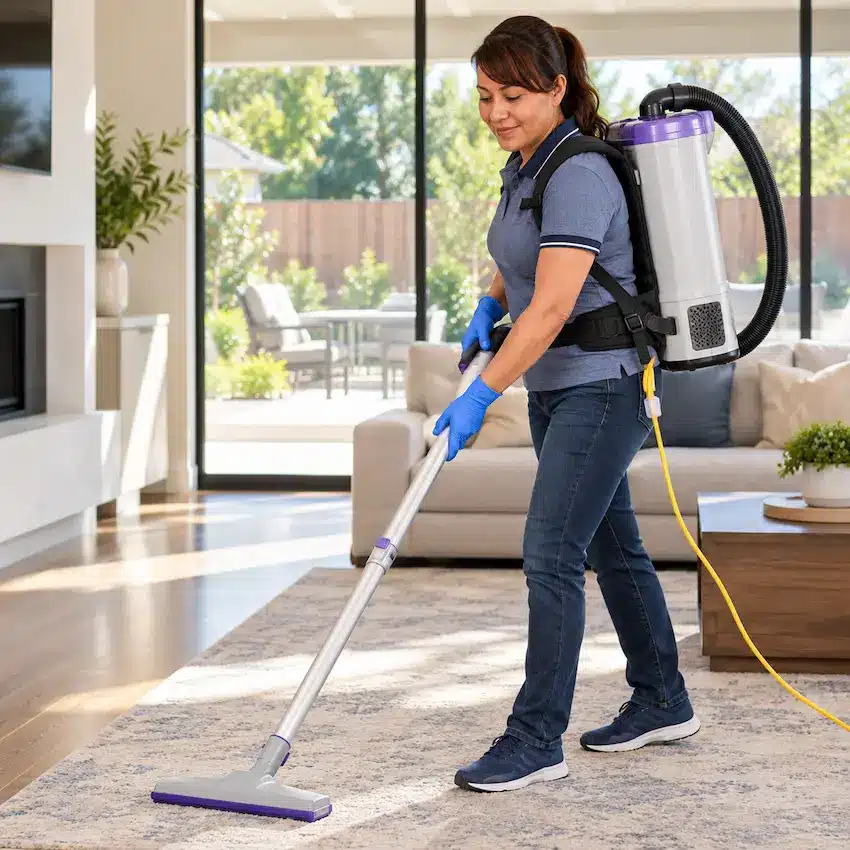
A backpack vacuum is usually the better choice for allergies because its filtration is sealed and the final filter sits after the motor, so fine dust isn’t blown back into the room. The ProTeam backpacks our team uses in Allen capture 99.86% of particles 0.3–5 microns (tested to ASTM F3150). Uprights still have an edge on thick carpet.
You vacuum, the rug looks great, and two days later there’s a gray line along the baseboards and the room feels dusty again. That usually isn’t about how hard you vacuumed. It’s about where the dust went: back out the exhaust, into the air, or into the corners the machine never reached. This guide compares backpack and upright vacuums on the things that matter for allergies, and it’s part of our house cleaning tips for Allen-area homes.
In this guide
Backpack Vacuum vs Upright for Allergies: Why Filtration Matters More Than Suction
The particles that matter most in allergy-prone homes are microscopic: pet dander, dust mite debris, and broken-down pollen. Picking them up is the easy part. Almost any vacuum with decent suction pulls them off the floor.
The hard part is what happens next. A vacuum is also an air pump: every bit of air it pulls in, it pushes back out. If that exhaust air isn’t filtered, or if the body leaks around the filter, the machine lifts fine dust off the floor and sends it back into the air you breathe. You end up with a carpet that looks clean and a room that doesn’t feel any better.
So for allergies, the right question isn’t “how strong is it?” It’s “what comes out the back?”
What 4-Level Filtration with HEPA Media Actually Means
The ProTeam backpack vacuums our team carries move air through four stages before it leaves the machine:
- Disposable micro-filter bag. Catches the bulk of the dust, hair, and debris.
- Reusable micro cloth filter. Holds back what gets past the bag.
- Foam filter on a protective cage. Shields the motor from fine particles.
- Post-motor HEPA media filter. Cleans the exhaust air as the very last step, after the motor.
That last stage is the one most household vacuums don’t have. Because it sits after the motor, it also catches anything the motor itself stirs up. The result: ProTeam 4-level ProLevel filtration with HEPA media captures 99.86% of particles 0.3–5 microns (tested to ASTM F3150).
That number is measured on the whole vacuum, not on a filter sitting alone on a lab bench. That distinction matters, because a great filter inside a leaky machine still lets dust escape around it.

The machine stays on the cleaner’s back, so the wand goes wherever the dust is: along walls, up the stairs, into vents, and across upholstery, without switching machines.
- The crevice tool follows the seam where the carpet meets the baseboard.
- The dusting brush handles vents, blinds, and lampshades.
Backpack vs Upright: Side by Side for Allergy Homes
Neither machine wins everything. Here’s an honest comparison on the factors that change how a home with allergies feels after cleaning.
| Factor | Backpack with 4-level filtration | Typical household upright |
|---|---|---|
| Exhaust air | Sealed path; the last filter sits after the motor | Varies by model; many filter only before the motor |
| Baseboards and wall seams | Wand and crevice tool reach into the seam | The wide head stops short of the wall |
| Stairs, vents, upholstery | Same machine, change the tool | Hose attachments or a second machine |
| Around furniture | Machine stays on your back; only the wand moves | Pushed, tipped, and turned around legs |
| Thick carpet | Strong surface pickup; less agitation without a power head | Brushroll lifts grit buried deep in the pile |
Where an Upright Misses the Dust That Builds Up
Fine dust and dander don’t sit in the middle of the rug waiting for you. They collect where air slows down and where furniture blocks the vacuum:
- Baseboards and wall seams. The gray line you see two days after vacuuming.
- Under and behind furniture. Sofas, beds, and media consoles hide weeks of buildup.
- Upholstery and mattresses. Fabric holds dander and dust mite debris that floors don’t.
- Stairs. Every step edge is a small baseboard.
- HVAC returns and supply vents. Dust on the grilles goes right back into circulation.
- Window tracks and blinds. Pollen that comes in through the windows settles here first.
If those spots sound familiar, you’ll recognize the pattern in our guide on why dust builds up so quickly in Allen homes.
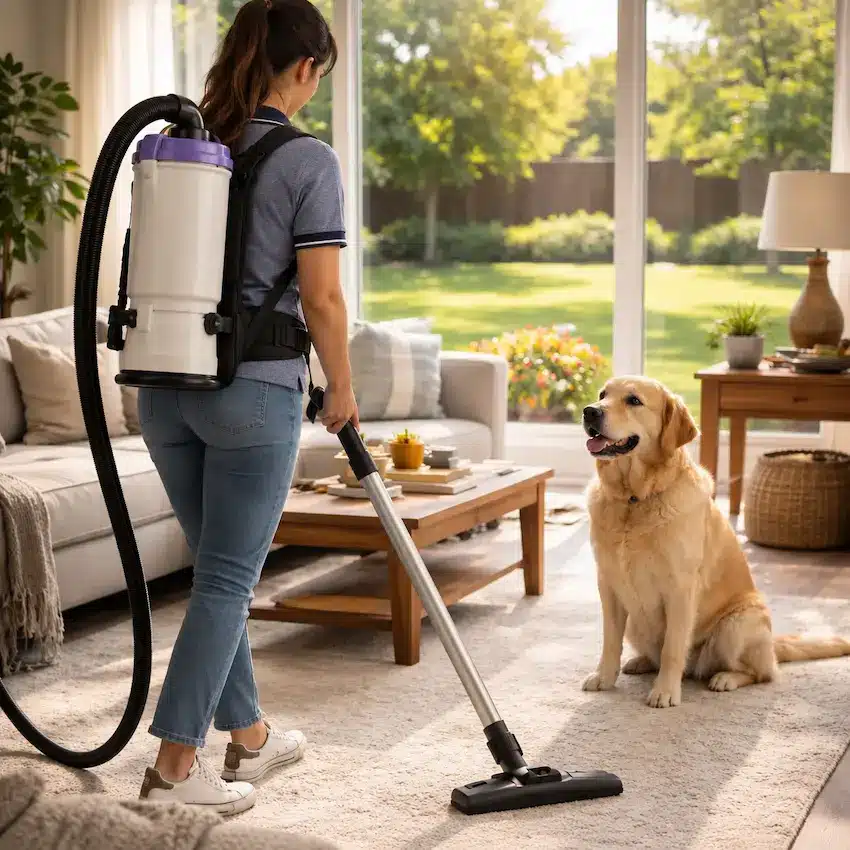
Dogs and cats leave dander where they rest, not where you vacuum. Cushions, seams, and the base of the sofa need the same attention as the rug.
- Vacuum cushion seams and the sofa skirt, not just the seat tops.
- Do the pet’s favorite spots every visit, not once a month.
Want the whole house done with HEPA media filtration, edges included?
See Allergy-Friendly CleaningWhy the Vacuum Matters More in Allen, Plano, and McKinney Homes
Homes here give your vacuum more to deal with than most places. Mountain cedar peaks in winter, oak takes over in spring, and ragweed runs from late summer into fall. Air conditioning and heat keep the HVAC running most of the year, which keeps moving whatever settles in the house. New construction nearby adds fine dust, and pets bring all of it in on their coats.
That steady load is why exhaust filtration and edge reach matter more here: there’s always a fresh layer, and a vacuum that recirculates part of it is fighting itself. Our Allen allergy season cleaning guide breaks down what each season brings indoors.
Using an Upright at Home? How to Get Closer to Backpack Results
You don’t need to buy new equipment to get better results between professional visits. A few habits close much of the gap:
- Do the edges first. Run the crevice tool along baseboards before the main pass, so the upright picks up what you loosen.
- Dust before you vacuum. Work top to bottom so whatever falls from shelves and fan blades lands on a floor you haven’t vacuumed yet.
- Go slow. Slow, overlapping passes pick up more than rushed strokes.
- Empty outside. Empty bagless canisters outdoors, or use bags if your model takes them.
- Replace filters on schedule. A clogged filter cuts airflow and lets more dust slip past.
The Bottom Line
For allergies, the right vacuum isn’t the one with the most suction. It’s the one that keeps fine dust sealed inside and reaches the edges where it collects. That’s why Maid in Allen TX cleans with ProTeam backpack vacuums on a 14-day allergen cycle, so buildup never gets the chance to settle back in. We’ve served homeowners in Allen, Plano, McKinney, Frisco, and Fairview since 2009. If you’d like the same team handling it every other week, see our bi-weekly cleaning in Allen.
Keep Reading
Frequently Asked Questions
Is a backpack vacuum better than an upright for allergies?
Usually, yes. A backpack vacuum with sealed, multi-level filtration cleans the exhaust air after the motor, so less fine dust goes back into the room. Its wand and tools also reach baseboards, stairs, vents, and upholstery, where fine dust and dander collect. An upright with a brushroll still does better on thick, plush carpet.
What does “HEPA media” mean on a vacuum?
It means one of the vacuum’s filters is made from HEPA-grade filter material. That alone doesn’t tell you how the whole machine performs, because air can leak around a filter. A whole-system test, such as ASTM F3150, measures what the complete vacuum actually captures.
Do backpack vacuums work on carpet?
Yes. They pick up surface dust, hair, and debris from carpet well, and they’re excellent on area rugs and low-pile carpet. Without a powered brush head they agitate deep pile less than an upright with a brushroll, so very plush carpet benefits from that extra pass.
How often should you vacuum if someone in the home has allergies?
Vacuum high-traffic floors and pet areas a few times a week, and do a full clean of edges, upholstery, and vents every two weeks. That two-week rhythm removes buildup before it settles back into fabrics and HVAC returns.
Does Maid in Allen TX bring its own vacuums?
Yes. Our team brings ProTeam backpack vacuums with HEPA media filtration, along with EPA Safer Choice products, to every home we clean in Allen, Plano, McKinney, Frisco, and Fairview.